
Forgiveness : A necessary evil
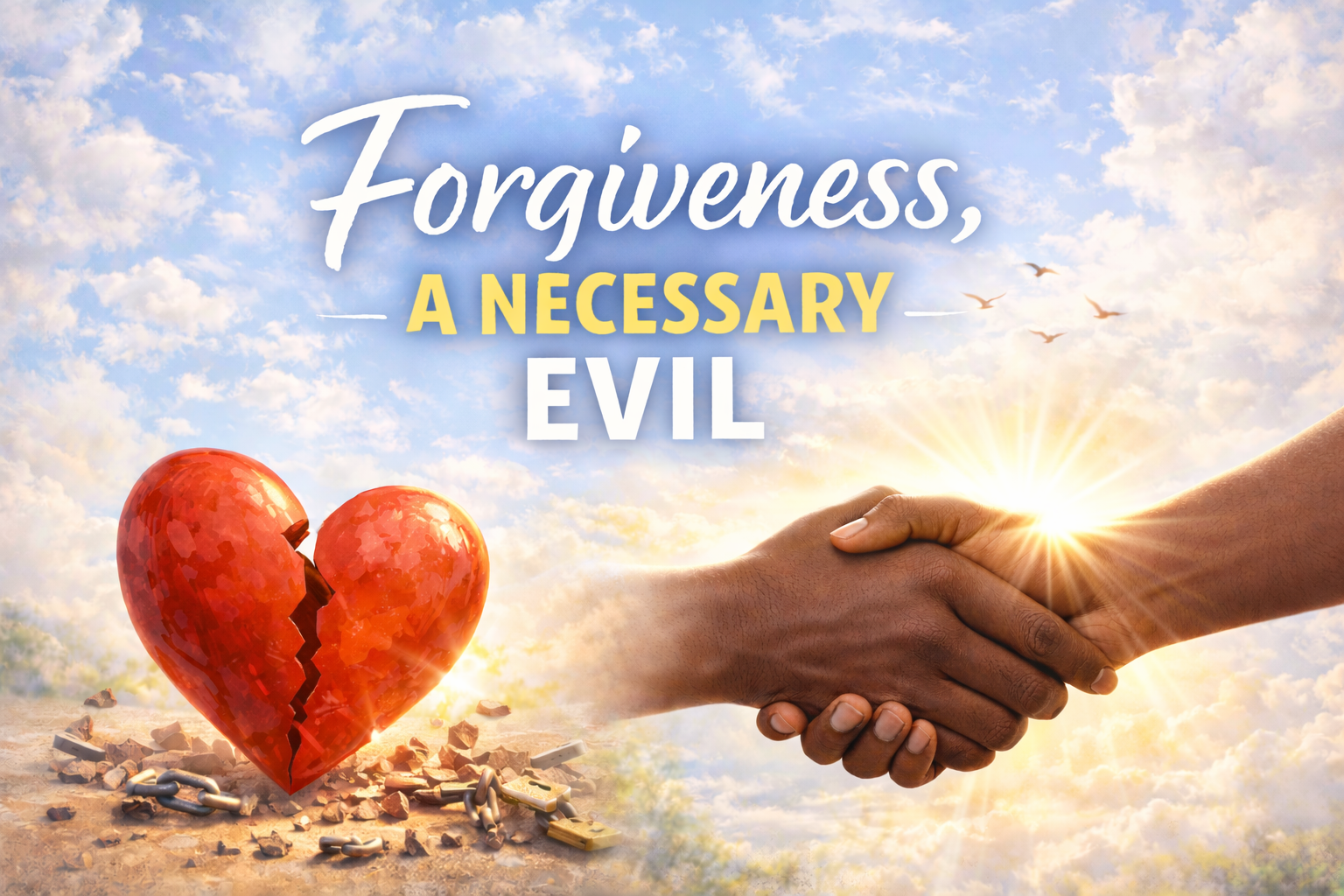
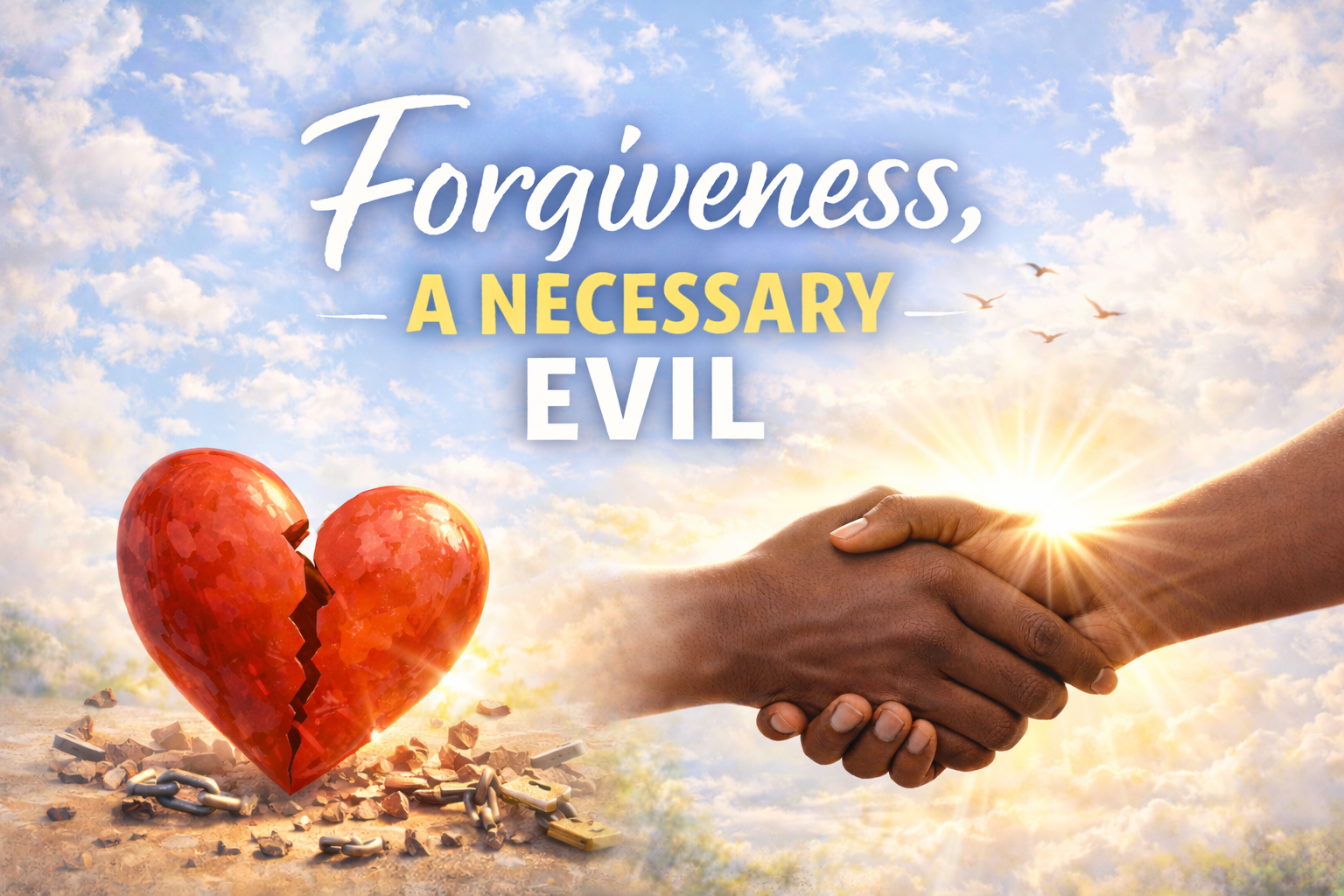
Throughout our entire life on earth, I would say it is absolutely impossible not to be offended, hurt, disappointed, or betrayed. Most often, these experiences come from those close to us—people we value—because for there to be hurt or betrayal, there must first have been expectation or trust. Otherwise, we would not speak of hurt or betrayal, but at most of offense or simple disappointment.
We live in a world of constant interaction with one another, and there are as many ways of perceiving situations or viewing life as there are individuals on earth. This inevitably creates differences in how we approach situations and how we react to them.
While it is true that offense, hurt, and betrayal are part of the human experience, our reaction to these situations is an entirely different matter. We will never all react the same way.
That being said, we must still agree on one fundamental consensus: forgiveness is a necessity—what I would call a necessary evil. Yes, forgiving is difficult and requires a certain level of willpower and effort, but this “evil” is life-giving and restorative. That is what we will explore next.
What does it mean to forgive?
The word forgive comes from the Latin per-donare:
- per → completely, fully, all the way through
- donare → to give
To forgive therefore literally means to give completely.
It is not giving partially.
It is not giving conditionally.
It is giving beyond what is reasonable.
In legal and religious Latin, perdonare meant to cancel a debt, grant mercy, or abandon the right to punish.
The one who forgives voluntarily renounces a legitimate right.
When we examine this definition closely, we understand that forgiveness goes beyond rational thinking and common logic. It is the act of erasing a fault or injury that, according to human standards, is neither erasable nor tolerable.
I would even go so far as to say that forgiveness is more than giving—it is giving over and above. To forgive is to give over the offense or the harm done. Forgiving those who have hurt us is greater than simply giving or offering them something.
“Offering forgiveness is greater than offering anything else.”
This is why we read this striking statement in the Bible:“If you forgive, God will forgive you.”
It seems to be one of the rare moments where God openly conditions something we hope to receive on the fact that we first give it. As if forgiveness were the only spiritual currency God requires us to circulate before benefiting from it ourselves.
Forgiveness: A multidimensional concept
Let’s take a closer look.
- Forgiveness as a spiritual condition
Matthew 6:14–15 (NLT)
“If you forgive those who sin against you, your heavenly Father will forgive you.
But if you refuse to forgive others, your Father will not forgive your sins.”
Forgiveness is clearly conditional here.
Mark 11:25 (NLT)
“But when you are praying, first forgive anyone you are holding a grudge against, so that your Father in heaven will forgive your sins too.”
Forgiveness is directly linked to prayer and access to God.
- Forgiveness as a requirement of the heart
Matthew 18:21–22 (NLT)
Then Peter came to him and asked, “Lord, how often should I forgive someone who sins against me? Seven times?”
“No, not seven times,” Jesus replied, “but seventy times seven!”
Forgiveness has no measurable limit.
Matthew 18:35 (NLT)
“That’s what my heavenly Father will do to you if you refuse to forgive your brothers and sisters from your heart.”
The forgiveness required is inward, sincere, and complete.
- Forgiveness as imitation of God
Ephesians 4:32 (NLT)
“Instead, be kind to each other, tenderhearted, forgiving one another, just as God through Christ has forgiven you.”
God—not man—is the model for forgiveness.
Colossians 3:13 (NLT)
“Make allowance for each other’s faults, and forgive anyone who offends you. Remember, the Lord forgave you, so you must forgive others.”
Christian forgiveness is a response to forgiveness already received.
This list is not exhaustive, but it allows us to view forgiveness from several angles.
Why you must forgive even though it’s hard
It no longer needs to be said that although forgiveness is extremely difficult, it is a necessity—no, more than that, it is an obligation.
“Forgiveness is not a necessity; it is an obligation.”
- Reason #1: To free yourself from a heavy burden
As long as you have not forgiven a hurt, offense, or betrayal, it is like carrying a weight within your body—one that weighs you down both figuratively and literally. You may think you are moving forward and living happily, but there remains a shadow that prevents you from fully flourishing and traveling light.
- Reason #2: To recover your productivity
Constantly replaying a painful situation in your mind reduces your productivity. If your work requires creativity or imagination, you will notice that when you are deeply angry, your creativity diminishes. It’s as if your signal suddenly loses clarity and frequency.
- Reason #3: We all emit a spiritual “scent”
Whether we realize it or not, each of us emits a spiritual “fragrance.” By holding onto anger or resentment, we unintentionally release an unpleasant scent in the spiritual realm, making the version of you that your blessings are seeking either partially or completely unreachable.
- Reason #4: Holding on will not erase the pain
Whatever harm you have suffered, only God is capable of granting the necessary restoration. As humans, our understanding and perception of events are terribly limited. Very often, what you see as the harm is only the visible tip of a much deeper iceberg.
This is why justice must be entrusted to God. He has the full picture. He sees not only the harm you endured but also the hidden dynamics behind it.
How can you forgive?
There is no miracle formula here. I will not attempt to impress you with supposed rules for forgiveness.
The equation is simple: Forgiveness = Decision + God’s Help
Forgiveness is first and foremost a decision—or better yet, a resolution. Borrowing from Dr. Raoul Wafo’s perspective, a resolution is a firm decision you choose to uphold by all means necessary.
It is deciding deep within your soul that regardless of what X did to you, you forgive because it is better for you.
Let me be honest with you: deciding to forgive does not make it easy. On the contrary, every time the memory resurfaces, a small voice will whisper:
“Are you sure you really want to forgive? What they did was cruel. You can’t—and shouldn’t—forgive.”
This emotional ambivalence is completely normal. Your soul is deeply wounded and resists forgiveness because it is the one that feels the pain. Meanwhile, your mind wants to forgive because it knows it is the healthier choice.
At that moment, it is no longer about willpower. There is only one thing to do: ask God for help in prayer.
“My God, my Father, I truly want to forgive X, but I can’t do it on my own. Help me…”
If you are sincere in this process, you will come to genuinely forgive.
The implications of forgiveness
Although forgiveness means renouncing personal justice after having been wronged, it carries implications that may seem contradictory but are not.
Let us clarify what forgiveness is not in order to understand its true implications.
- Forgiveness is not denying the wrong
Forgiving does not mean pretending nothing happened.
A wrong remains a wrong.
A harm remains a harm.
Forgiveness fully acknowledges injustice without minimizing or justifying it. In that sense, forgiveness is already a moral judgment:
What was done was wrong, but I refuse to be imprisoned by it.
- Forgiveness Is Not Forgetting
Forgiveness does not erase memory; it prevents memory from becoming a weapon.
Learning lessons is part of forgiveness: setting boundaries, recognizing warning signs, adjusting trust, refining discernment, and sometimes changing relational posture.
Forgiving without learning is not spiritual—it is reckless.
- Forgiveness does not necessarily mean reconciliation
Forgiveness is a personal, internal act.
Reconciliation is a relational, two-person process.
You can sincerely forgive while choosing not to restore the relationship or while maintaining healthy distance.
Reconciliation requires acknowledgment, repentance, and often visible transformation. Without these, forgiveness creates no relational obligation.
- Forgiveness is not the absence of justice
Forgiving does not eliminate consequences. In some cases, boundaries must be set, responsibilities assumed, and human justice allowed to run its course.
Forgiveness frees the heart, not necessarily the offender from consequences.
- Forgiveness does not replace an apology
Forgiveness offered without repentance frees the one who forgives but does not justify the act nor automatically restore the relationship.
When the offender acknowledges their wrong and asks for forgiveness, forgiveness becomes a bridge. Without that step, forgiveness remains unilateral—healthy, but clear-eyed.
- Forgiveness as a spiritual judgment (The burning coals concept)
Forgiveness does not suspend discernment. It refuses revenge while maintaining moral clarity.
Forgiveness does not say “It wasn’t serious.”
It says “It was serious, but I refuse to be destroyed by it.”
Romans 12:20 (NLT)
“Instead, ‘If your enemies are hungry, feed them. If they are thirsty, give them something to drink. In doing this, you will heap burning coals of shame on their heads.’”
By refusing to repent and change, the offender ultimately condemns themselves.
We have seen and understood this clearly: forgiveness is a necessary evil. It will never be easy. Each offense leaves its own unique imprint. But with our willingness—and above all, with God’s help—it is possible.
Philippians 4:13 (NLT)
“For I can do everything through Christ, who gives me strength.”
“Faith doesn’t make things easy; it makes them possible.” — Dr. Raoul Wafo
Stay blessed and strengthened.
We’re in this together.
SBE
Published on
Did this article speak to you?
Did this article touch you? Share your testimony →
Your thoughts
No sign-up. A first name and your message are enough. Comments are reviewed before they appear.
Loading comments…