
Faith hears & listens
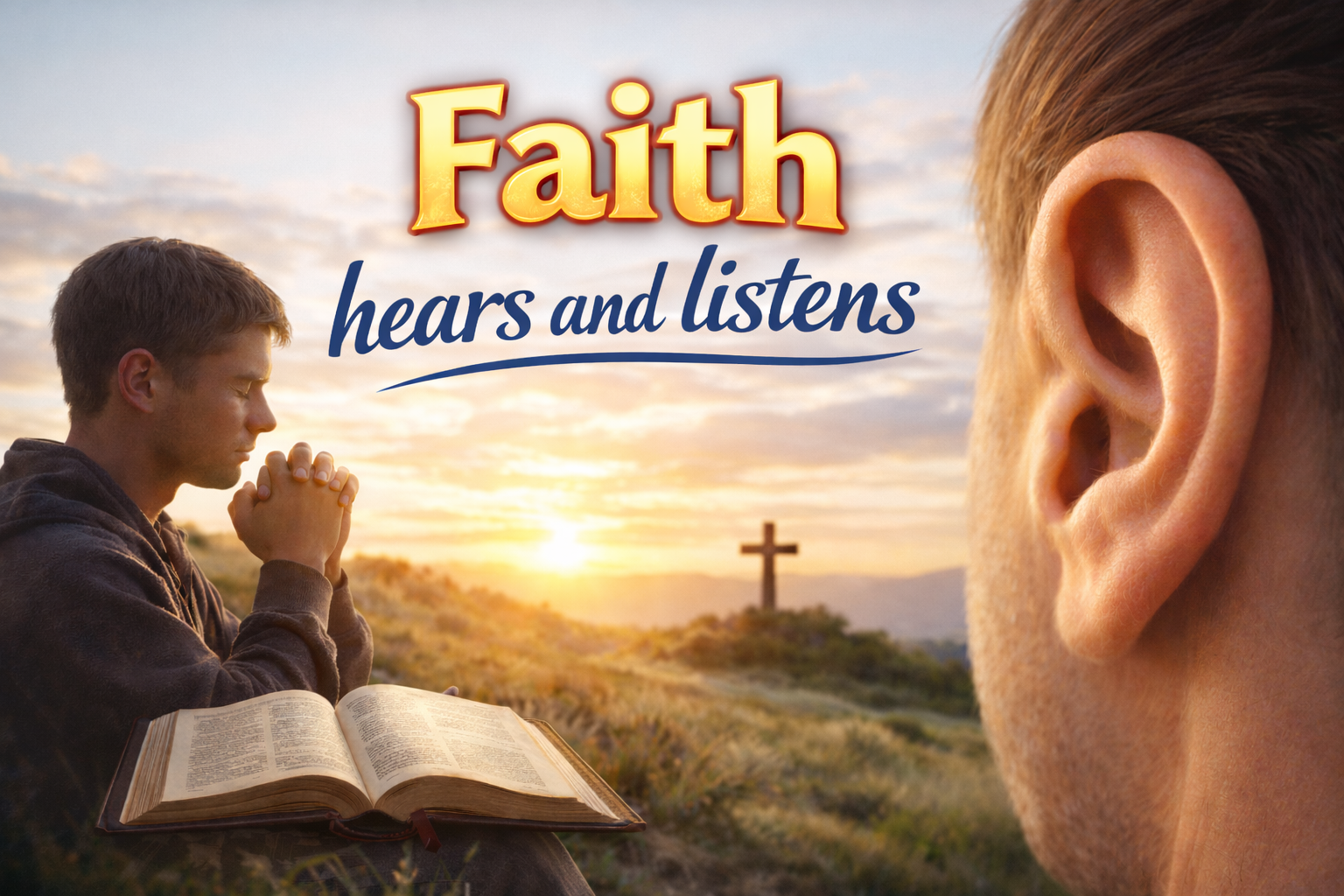
Romans 10:17 (NLT)
“So faith comes from hearing, that is, hearing the Good News about Christ.”
Very often we know that we should listen to God, but today we are going to look more closely at the fact that faith hears and listens. Hearing is not necessarily listening, but listening requires having heard first.
What’s the difference between hearing and listening
There’s a very simple but essential difference between hearing and listening.
To hear is to perceive a sound with our ears without necessarily paying attention to it. It’s passive. For example, we can hear rain falling on the roof without really thinking about it.
To listen, on the other hand, is a voluntary act. It’s to pay attention, to understand, and to make sense of what we hear. When we listen to someone, we really try to grasp their words, their message, their intention.
In summary: hearing is catching sound; listening is receiving the message.
"Sometimes we hear God without truly listening!"
In the spiritual world, things work a bit differently from our physical perception — we are not limited to ears alone as in the physical world.
To “hear” spiritually is not limited to physical ears. It can be an internal perception, an intuition, a deep sense, or an impression received in the heart or spirit. For example, when the Bible speaks of the “ear of the heart,” it refers to perceiving God’s truth with our heart, not merely with our physical ears. Hearing spiritually can also often come through dreams or visions.
Logos and rhêma
In the spiritual life, there is an important difference between logos and rhêma, and understanding this distinction can transform how we receive God’s Word.
Logos is God’s Word as it is written in the Bible. It is stable, universal, and true for everyone. It’s what we can read, study, and memorize. For example, “God is love” is logos — it is true for all times and all people.
Rhêma, on the other hand, is the Word that becomes alive in our lives. It is the message God gives to you, here and now. It is what touches our hearts and enlightens a specific situation. For example, reading “God is love” and deeply sensing today that He is taking care of you during a difficult moment — that’s rhêma.
In summary: logos is the universal text, the written Word. Rhêma is that same Word that becomes alive and personal, resonating in your heart when you need it.
The different forms rhêma can take
Rhêma can manifest in several ways in our lives, because it is the living Word speaking to you personally. Here are the main forms it can take:
- An inner impression or feeling
• Sometimes God speaks through a strong conviction in your heart.
• Example: You sense inwardly that it’s the right time to make a decision or to forgive. - A thought that arises spontaneously
• An idea, a verse, or a biblical phrase can come to mind unexpectedly, directly answering your situation.
• Example: You are thinking through a problem and a specific verse clearly comes to mind, giving you direction — or even a song comes to you unexpectedly. - A word or verse read in the Bible
• Sometimes it’s the actual reading of Scripture that becomes personal and alive.
• Example: You read a passage and suddenly it applies directly to what you are going through. - A word or advice received from another person — not necessarily a believer
• God may speak through a sermon, a conversation, or an encouragement from someone else.
• Example: Someone shares a message that speaks right to your heart and guides you in a precise situation. - A sign, a dream, or a vision
• In some cases, rhêma may manifest symbolically or spiritually: a dream, a vision, or a particular sign.
• Example: A dream that shows you the solution to a problem or confirms a decision.
In summary: Rhêma is the Word that becomes alive to you here and now, and it can show up in your heart, your spirit, through texts, the words of others, or even through symbolic experiences.
Putting our faith into action
In conclusion, to have faith — that is, to put your faith into action in a situation — you need to know God’s will regarding that situation.
For example: if you have a health challenge, you know that God’s will is for you to be well, as we read in 3 John 1:2 (NLT):
“Dear friend, I hope all is well with you and that you are as healthy in body as you are strong in spirit.”
You then put your faith into action so that health becomes real in your life.
Two possible situations when we feel lost
You may be in a season of life where you feel lost and don’t know which direction to take. Here are two possible scenarios:
- You are completely lost and have no idea what to do:
In this case, you must wait at the Master’s feet in prayer, asking for direction and instruction before you move.
“When you are in a season where you are exerting too much effort without results, you need to stop and wait for the next instruction.” — Dr. Raoul Wafo
- You have a partial revelation of what God wants from you, or a general sense, but you don’t know where to start:
Here, you should ask the Holy Spirit for clarity in prayer. But it’s important to know that He will not always answer the way you expect, perhaps not with perfect precision. In that case, the guidance I’ve learned from the teachings of Dr. Raoul Wafo is to take one or more steps that you know are not contrary to God’s will. In doing so — even if you make a mistake — He will redirect you.
We must keep in mind that even though faith listens to God, God’s plan will not always be crystal clear in our minds at every moment. Even those moments of trial and wandering are part of His plan for us.
In any case, if there’s one thing to take away from everything we’ve just said, it’s this: stay daily at the Master’s feet to receive His instructions.
Keep your faith strong, my brother, my sister.
We are in this together.
SBE
Published on
Did this article speak to you?
Did this article touch you? Share your testimony →
Your thoughts
No sign-up. A first name and your message are enough. Comments are reviewed before they appear.
Loading comments…